Table of Contents
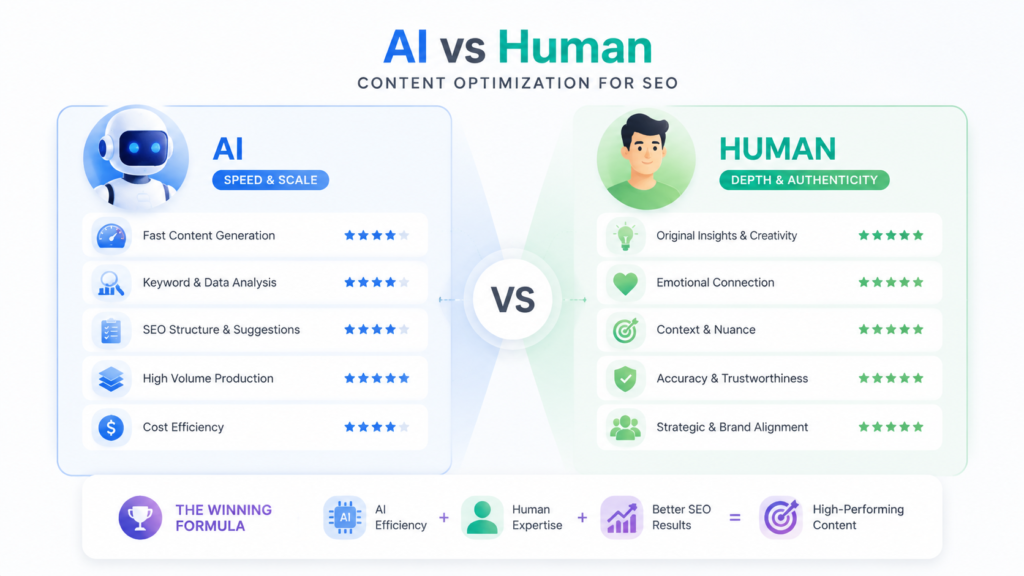
If you have typed “AI vs content” into Google more than once this year you are not alone. Every client I work with eventually asks some version of the question: can AI actually handle content optimization for SEO or do I still need a human writer for this?
I run an SEO consultancy. I have tested this question across dozens of client accounts over the past couple of years. Not in theory but in live rankings live traffic and live client budgets. The answer to the question of AI vs content is not “AI is better” or “humans are better” when it comes to AI vs human content. The answer to the question of AI vs content is more specific than that and the nuance is exactly what most generic articles on the topic of AI vs human content skip.
My Real-World Experience Testing AI vs Human Content
When I work with clients I like to try out two types of content at the same time. I use content that is written by intelligence and content that is written by humans. I do this for topics and I see what happens over a few months.
I have been doing this for a while now. I have seen a pattern. This pattern is consistent so I now use it when I plan my projects.
The artificial intelligence content does a job on simple topics. These are topics where you need to give people information or instructions. Think about guides that tell you how to do something or posts that compare things. The artificial intelligence content is good at giving people clear and complete information quickly.
There are some types of content where the artificial intelligence does not do as well. This is when you need to have an opinion or a point of view. For the Topic content optimization for SEO For example if you are writing about a case study or a topic where you need to convince people that you are right. In these cases the content written by humans is better. People are more likely to trust the human-written content. They will spend more time reading it. They will also come back to read more. This is what I have learned from my experience, with client work and artificial intelligence content and human-written content.
Why This Split Happens (And What It Means for Content Optimization for SEO)
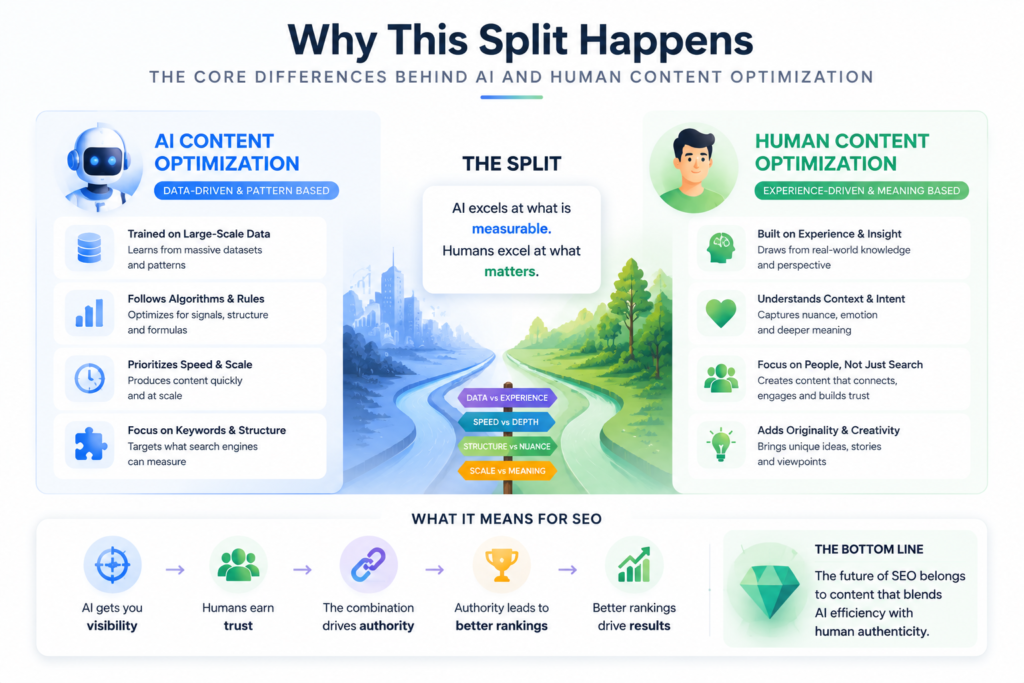
This isn’t really about AI “declining” at writing. It’s about what search engines are actually trying to reward.
Google’s ranking systems are looking more and more at signals around Experience, Expertise, Authoritativeness, and Trustworthiness, or E-E-A-T for short. This is outlined in Google’s Search Quality Rater Guidelines as part of how we determine whether content shows the sort of firsthand knowledge and trustworthiness that aids searchers.
That’s a hard thing for AI to fake convincingly at scale — not because it can’t produce fluent sentences but because it doesn’t have a client story, a failed test, a lesson learned to draw from.
And that gap is exactly why content optimization for SEO can’t just be about “getting the keywords right.” That means constructing in the kind of first-hand detail only a person with real experience can provide.
The Approach I Actually Use With Clients
My process isn’t a rigid formula — it genuinely varies by client, industry, and content type. But the underlying blend looks like this:
- Use AI for the groundwork: Research, keyword clustering, competitor gap analysis, and rough structure — AI speeds all of this up significantly for SEO optimization.
- Bring in human writing for anything opinion: or trust-driven. Case studies, client stories, “here’s what I’ve seen go wrong” sections — these get written or heavily rewritten by a person with actual experience in the topic content optimization for SEO.
- Fact-check everything AI Touches : the tricky about ai is how sure it sounds.it will throw out stats and claims like its 100% right,even when the info is old or just plain wrong Every number gets verified before it goes live.
- Read it out loud before publishing: If it sounds like it was written by a committee of search engines instead of a person, it gets rewritten.
This blended approach is slower than pure AI generation, but it’s also the version of “content optimization for SEO” that actually holds up over time instead of just spiking and fading.
The Biggest Mistake I See With AI SEO Content
If there’s one mistake that comes up again and again, it’s over optimizing for keywords at the expense of readability.
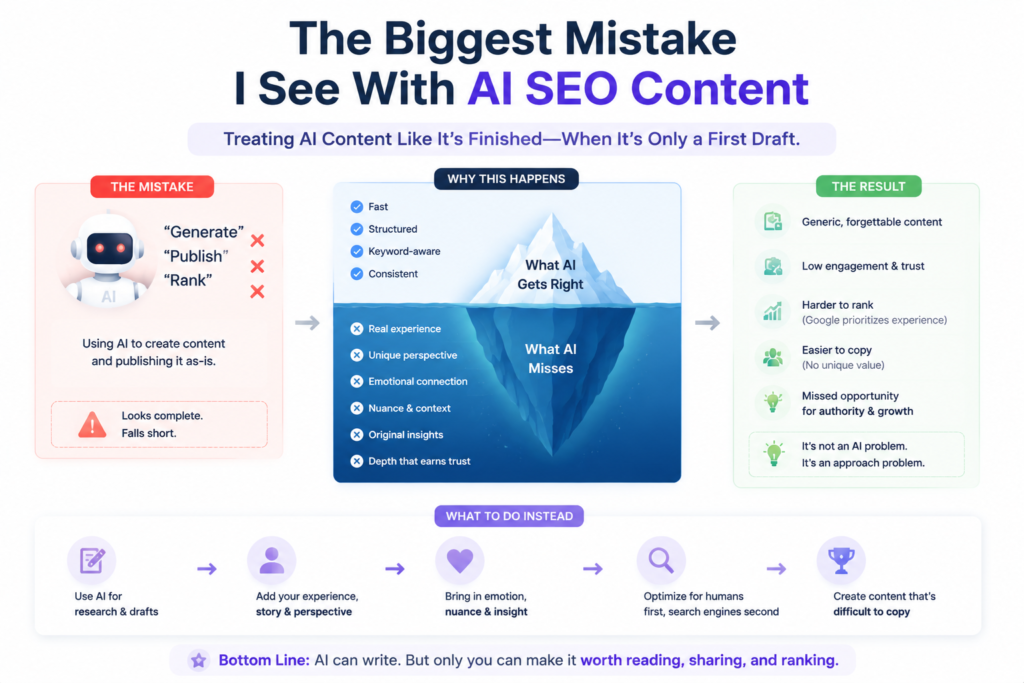
I’ve seen AI-assisted drafts that technically hit every keyword density target on a checklist — and read like they were written for a robot instead of a person. Sentences get twisted into awkward shapes just to fit a phrase in one more time. Readers notice. So does Google, increasingly, since user engagement signals feed back into how content performs over time.
AI vs Human Content: A Quick Comparison
| Factor | AI-Generated Content | Human-Written Content |
| Speed to produce | Very fast | Slower |
| Best for | How-to guides, definitions, straightforward informational content | Opinion pieces, case studies, trust-driven topics |
| E-E-A-T strength | Weaker on Experience and Trust | Stronger across all four pillars |
| Risk of factual errors | Higher without fact-checking | Lower, but still requires verification |
| Cost at scale | Lower | Higher |
| Long-term ranking stability | Mixed, depends on quality control | Generally more durable |
- Publishing AI drafts with no human review or fact-check pass
- Chasing keyword density numbers instead of natural phrasing
- Skipping firsthand examples because “the AI version reads fine”
- Assuming one approach works for every content type across a site
- Ignoring how content actually performs after publishing, not just before
Frequently Asked Questions
Is AI content bad for SEO? It is not necessarily so. There is nothing inherently wrong with AI content, provided that it is properly fact-checked and not overly optimized for keywords and search terms in pursuit of better rankings.
Can I use AI plus human writing in the same article? Yes. This usually works best. You can get the help of AI to do research and organize the writing. People can write the parts that need human insight or experience.
Will Google punish AI-generated content in particular? Google has said its guidance is about the quality and helpfulness of content, not how it was generated. The low quality stuff, whether it’s from AI or humans, tends to do poorly.
Conclusion: The Real Answer to AI vs Human Content Optimization for SEO
I’ve actually tried this out on real client accounts. My honest conclusion? Content optimization for SEO isn’t about AI vs. humans. It’s about knowing where each deserves to play. Leave research, structuring, and basic informational content to the AI. The parts where trust, opinion and first hand insight actually move the needle will be carried by human experience.
If you’re working on a content strategy right now for content optimization for SEO, , audit your existing content first. Which pieces are just informational, and which ones are based on your team’s real expertise to be credible? That split will tell you exactly where to apply AI for content optimization for SEO, and where to safeguard the human voice.